
Views: 0 Author: Site Editor Publish Time: 2026-08-05 Origin: Site


A failing wiper motor creates immediate safety hazards during adverse weather, violates roadworthiness compliance, and forces commercial vehicles into unplanned downtime. Replacing this component is significantly more complex than swapping wiper blades. Buyers must match exact mechanical fitment, electrical load compatibility, internal park switch configurations, and varying supplier quality tiers to avoid premature failure. A mismatched unit might bolt up to the firewall but fail to communicate with the vehicle's control modules, leaving you with wipers that stop mid-glass.
This guide provides a technical framework for evaluating specifications, comparing factory replacements against aftermarket options, and mitigating common installation risks to ensure reliable, long-term operation. You will learn how to match torque output to your specific climate demands, verify electrical pinouts before installation, and perform the pre-installation calibrations required to prevent linkage damage.
Verify Electrical and Mechanical Specs: A successful replacement requires exact matching of voltage (12V vs. 24V), pin configurations, shaft splines, and mounting geometry.
Match the Motor to the Environment and Load: Standard automotive wiper motors are sufficient for daily passenger use, while heavy duty wiper motors are mandatory for commercial fleets, oversized windshields, heavy snow climates, and heavier winter blades.
Evaluate the Source: Prioritize an OEM wiper motor for guaranteed linkage geometry, or rigorously vet an aftermarket wiper motor supplier for ISO/TS 16949 compliance and documented load testing.
Mitigate Installation Risks: Most premature replacement failures stem from pre-existing linkage binding, degraded wiring harnesses, or incorrect "park position" calibration rather than the new motor itself.
A high-quality automotive wiper motor must generate sufficient rotational torque to push rubber blades across high-friction dry glass without overheating. Engineers calculate this torque requirement based on the length of the wiper arms and the aerodynamic downforce generated at highway speeds. Most standard passenger vehicles require a motor capable of producing between 25 Nm and 35 Nm of stall torque. If a motor lacks this necessary torque reserve, it will stall prematurely when clearing heavy rain or road debris.
Sweep angle is equally demanding. The internal worm gear and crank mechanism dictate exactly how far the wiper arms travel across the windshield. Most passenger vehicles require a sweep angle between 90 and 110 degrees. If you install a motor with an incorrect internal gear ratio or a mismatched crank arm length, the blades will either strike the A-pillars, damage the cowl panel, or leave massive uncleared blind spots in the center of the glass.
Operating environments directly impact component lifespan. Vehicles in regions with heavy rainfall or dense, wet snow experience significantly higher mechanical resistance. Upgrading to heavier winter blades or thick beam-style blades adds physical weight and increases the friction coefficient against the windshield glass.
The motor must possess adequate torque reserves to handle these adverse weather conditions. A standard motor might operate perfectly in a mild southern climate but burn out within a single winter season up north when forced to push heavy snow loads off a frozen windshield. Evaluating your local climate dictates whether a standard replacement is sufficient or if an upgraded, higher-torque unit is necessary to maintain visibility during severe storms.
These components live in harsh environments. They sit in the cowl area directly beneath the windshield, exposed to water runoff, road salt, freezing temperatures, and engine bay fluids. Ingress protection is non-negotiable for long-term survival. Cowl drains frequently clog with leaves and pine needles, which can submerge the motor housing in standing water.
Durable automotive components require specific IP (Ingress Protection) ratings. Look for motors rated at IP65 or higher. This ensures the internal copper windings, brush cards, and electronic park switches remain protected from high-pressure water and corrosive salt spray. Poorly sealed housings suffer from rapid internal corrosion, leading to short circuits, rusted bearings, and total mechanical failure.
Quality units incorporate thermal limiters, such as PTC thermistors, to protect the vehicle's broader electrical system. If the wiper blades freeze to the windshield overnight and the driver turns the switch on, the motor will attempt to draw massive amounts of amperage to break them free. A standard motor can pull upwards of 30 amps during a hard stall.
Without thermal protection, this amperage spike can melt internal wiring, blow primary fuses, or damage the Body Control Module (BCM). A built-in thermal limiter detects the rapid temperature increase and temporarily cuts power to the motor during a jam. Once the housing cools down, the circuit resets, preventing catastrophic internal melting and preserving the vehicle's electrical integrity.
Choosing an OEM wiper motor provides absolute certainty regarding fitment and geometry. Original equipment parts guarantee exact alignment with the factory wiper transmission linkage and the firewall mounting points. You will not need to modify brackets, splice wires, or force bolts into misaligned holes. The taper angle on the output shaft will perfectly match your factory crank arm.
OEM components also offer a predictable lifespan. They undergo the exact lifecycle testing required by the vehicle manufacturer, often exceeding 1.5 million continuous wipe cycles in laboratory conditions. However, dealership sourcing often involves premium markups and potential supply chain delays for older or less common vehicle platforms.
The aftermarket sector offers a broad spectrum of quality. Some manufacturers produce premium direct-fit replacements that rival or exceed factory specifications, utilizing upgraded bearings and thicker copper windings. Others produce reverse-engineered budget options that downgrade internal components, swapping durable POM plastic gears for cheap nylon and using thinner gauge wire.
Buyers must watch out for consolidation risks. Some aftermarket brands consolidate part numbers to reduce their own inventory costs. They create "universal" motors designed to fit multiple vehicle platforms. These often require splicing factory wiring harnesses, swapping connector pigtails, or modifying mounting brackets to achieve a proper fit. Avoid universal motors whenever possible; always insist on a direct-fit replacement engineered for your specific chassis.
Certain applications push standard motors beyond their design limits. A heavy duty wiper motor is engineered specifically for high-stress environments and continuous operation.
Transit buses and commercial coaches with massive, flat windshields that require 30-inch blades.
Agricultural tractors and construction equipment exposed to heavy dust, mud, and continuous vibration.
Marine applications requiring extreme saltwater corrosion resistance and sealed marine-grade connectors.
Snowplows that constantly battle freezing precipitation and heavy snow loads during 12-hour shifts.
Classic car restorations requiring modernized, high-torque systems to replace outdated vacuum-driven wipers.
Structurally, heavy-duty models feature distinct physical upgrades. You will find larger copper windings that handle higher continuous amperage without overheating. They utilize all-metal internal gears or high-density reinforced polymers instead of standard nylon. Furthermore, they feature reinforced output shafts, often utilizing a dual-shaft design, to withstand the immense twisting forces generated by oversized wiper arms.
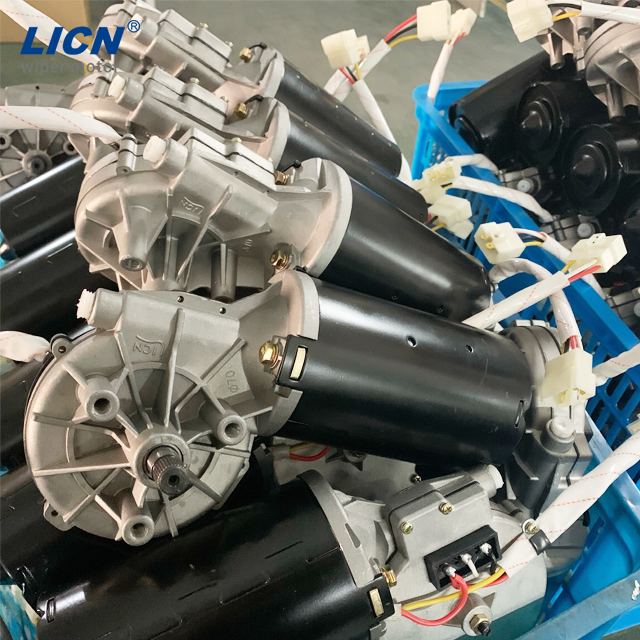
The interface between the motor and the vehicle's linkage is a common failure point during installation. The motor's output shaft must perfectly mate with the linkage crank arm. These shafts utilize specific splines and tapers. If the spline count is off by even one tooth, or the taper angle is incorrect, the crank arm will slip under load. This slipping strips the soft metal of the crank arm, causing the wipers to fail during operation.
Mounting bracket alignment is equally demanding. These motors generate significant vibration during direction changes. Factory setups use vibration-damping rubber grommets and brass crush sleeves at the mounting points to isolate this energy. A replacement motor must have exact bolt-hole spacing to utilize these grommets properly. Forcing a misaligned motor into place causes structural fatigue, eventually cracking the firewall sheet metal or snapping the aluminum motor housing.
Electrical compatibility goes beyond just plugging in a plastic connector. You must differentiate between standard 12V automotive systems and 24V commercial systems. Installing a 12V motor in a 24V system will immediately burn out the windings and melt the brush card. Conversely, a 24V motor in a 12V system will barely move the blades.
Amperage draw is another vital metric. A poorly wound motor draws excessive current. Modern vehicles route wiper controls through a Body Control Module (BCM) rather than a simple mechanical relay. Excessive amperage draw can permanently damage the solid-state drivers inside the BCM, turning a simple motor replacement into an extensive electrical repair requiring dealership programming.
Connector Type | Common Application | Functionality Supported |
|---|---|---|
4-Pin Connector | Older vehicles, basic commercial equipment | Ground, Low Speed, High Speed, Park Circuit |
5-Pin Connector | Modern passenger vehicles | Ground, Low, High, Intermittent/Pulse, Park Circuit |
6-Pin Connector | Advanced systems with moisture sensors | Ground, Variable Speeds, BCM Communication, Park, Sensor Data |
LIN Bus Connector | Luxury European vehicles | Digital network communication, precise sweep control, diagnostics |
The park switch ensures wipers return to the base of the windshield when turned off. This mechanism can be internal (built into the motor gear housing using rotary copper contacts) or external (mounted on the linkage itself).
Circuit logic varies wildly between manufacturers. The park switch maintains either a ground connection or a power connection until the exact resting degree is reached. Once the wipers hit the bottom of the glass, the switch physically breaks the circuit. If you install a motor with mismatched circuit logic—such as using a ground-side switched motor on a power-side switched vehicle—the wipers will stop dead in the middle of the glass the moment you turn the dashboard switch off.
Evaluating a replacement part based solely on the upfront purchase ignores the realities of automotive repair. The true penalty of cheap motors lies in the labor required for installation. Accessing the wiper motor often requires removing the wiper arms, extracting the plastic cowl cover, removing the cabin air filter housing, and sometimes unbolting portions of the HVAC intake assembly. This process takes hours for a trained mechanic.
Installing a sub-par motor that fails six months later requires a complete second tear-down. For commercial operators and fleet managers, vehicle downtime is the most punishing metric. A delivery truck sitting in the shop waiting for a second replacement motor loses revenue every hour it remains off the road. Investing in a reliable, high-quality part upfront minimizes labor repetition and keeps vehicles operational.
When sourcing parts outside the dealership network, evaluating the manufacturer is mandatory. Look for a wiper motor supplier holding recognized quality management certifications, specifically ISO 9001 or IATF 16949. These certifications prove the manufacturer adheres to strict quality control, material traceability, and continuous improvement standards.
Investigate their testing protocols. Reliable suppliers are transparent about their engineering processes. Look for documented evidence of salt-spray testing for corrosion resistance, continuous lifecycle testing, and load-stall testing to verify thermal protection. A reputable supplier will readily provide specification sheets detailing stall torque, no-load RPM, and maximum amp draw.
Finally, evaluate the warranty and support structure. A strong warranty indicates confidence in the product. Look for coverage that spans a minimum of one year to a lifetime guarantee, explicitly covering both the mechanical gear assembly and the internal electrical circuitry.
Many wiper motors are replaced unnecessarily because the actual fault lies elsewhere in the electrical system. Pre-installation diagnostics are mandatory. Before condemning the original motor, test the wiper relay, the dashboard control switch, and the wiring harness for voltage drops. Use a multimeter to check for a full 12.6 volts at the connector under load. A corroded ground wire attached to the chassis will mimic the exact symptoms of a dying motor.
When installing the new unit, corrosion mitigation prevents future failures. Apply a small amount of dielectric grease to the pins of the new motor's connector. This seals out moisture, prevents fretting corrosion from vibration, and stops electrical resistance from building up over time.
The wiper transmission linkage transfers rotational energy from the motor to the wiper arms. Over time, the pivot shafts in this linkage lose lubrication, accumulate rust, and seize up inside their bronze bushings. A seized wiper linkage will immediately burn out a brand-new motor by forcing it into a continuous stall condition.
Always inspect the transmission assembly while the cowl is removed. Disconnect the linkage from the old motor and move the wiper arms by hand. They should move smoothly with minimal resistance. If you feel grinding, binding, or excessive stiffness, you must replace the entire wiper transmission assembly alongside the motor. Spraying penetrating oil on a severely rusted linkage is only a temporary fix that will fail again within weeks.
Never install a motor blindly. Bench testing is a highly recommended best practice. Apply 12V power and ground to the new motor prior to installation to verify basic operation across all speeds and to confirm the internal park position functions correctly.
In-vehicle calibration is the most critical step of the installation process. You must establish the true "park" position before attaching the linkage arms to the motor shaft.
Connect the new motor to the vehicle's wiring harness while it rests on the cowl.
Turn the vehicle ignition to the ON position.
Turn the wiper switch on, let the motor spin for five seconds, and then turn the switch off.
Allow the motor to come to a complete stop on its own.
Turn the ignition off and disconnect the battery.
This process ensures the motor's internal switch is in the exact resting position. Only after this calibration should you bolt the linkage crank arm to the motor shaft. Failing to do this can drive the wipers down into the cowl panel, scratch the hood paint, or force the blades entirely off the glass.
Choosing the right wiper motor requires evaluating exact mechanical fitment, electrical pinout compatibility, climate-specific load requirements, and internal gear durability. A successful repair hinges on understanding the physical demands placed on the system and selecting a component engineered to meet those specific challenges. Start your shortlisting logic by identifying the exact OEM part number for your chassis. If operating a commercial vehicle, off-highway equipment, or a custom build, filter specifically for heavy-duty upgrades that feature metal gears and higher torque ratings. Finally, select a supplier that provides transparent testing data, holds recognized manufacturing certifications, and offers robust warranty coverage.
Next Steps:
Locate your vehicle's service manual to confirm the exact OEM part number and connector pinout.
Inspect your current wiper linkage for binding, rust, or stiffness before ordering parts.
Request detailed specification sheets and testing protocols from your shortlisted suppliers.
Perform a voltage drop test on your factory wiring harness to rule out electrical faults.
Purchase dielectric grease and replacement cowl clips prior to beginning the installation.
A: Test the system with a multimeter. Check for 12V power at the motor connector when the switch is turned on. If power reaches the connector but the motor doesn't spin, the motor is dead. If there is no power at the connector, the issue likely lies with the relay, the dashboard switch, or a blown fuse.
A: Yes. Heavier winter blades and thick beam-style blades increase the physical weight and friction against the glass. This forces the motor to work harder, drawing more amperage and generating more heat. If your standard motor is already worn, the added stress of winter blades can cause premature failure.
A: For custom projects and classic car restorations, heavy-duty motors are excellent upgrades, provided you fabricate proper mounting brackets and ensure the wiring can handle the amperage. However, they rarely bolt directly into modern standard passenger vehicles due to different linkage geometries and physical size constraints.
A: A 4-pin connector typically controls basic functions: ground, low speed, high speed, and the park circuit. A 5-pin connector adds a dedicated circuit for intermittent or pulse wiping functions. You must match the pin count exactly to your vehicle's factory harness to retain full functionality.
A: This happens when the motor is installed without calibrating the park position first. If the linkage is bolted to the motor while the internal gear is mid-cycle, the wipers will stop in the wrong place. You must disconnect the linkage, cycle the motor on and off, let it park, and then reattach the linkage.
A: You only need to replace the linkage if it is damaged. Disconnect the linkage from the motor and move it by hand. If it binds, grinds, or feels excessively stiff, replace it immediately. A seized linkage will quickly burn out your new motor by forcing it to stall.
A: Look for suppliers that hold ISO 9001 or IATF 16949 manufacturing certifications. Ask for documentation regarding their testing protocols, specifically load-stall testing and lifecycle endurance testing. A reputable supplier will also offer a strong warranty covering both mechanical and electrical failures.


