
Views: 0 Author: Site Editor Publish Time: 2026-08-21 Origin: Site


Standard wiper motors routinely fail when subjected to extreme environmental loads. Heavy snow accumulation, thick mud, and continuous industrial operation push consumer-grade components past their mechanical limits. When these systems fail, the resulting equipment downtime creates severe operator safety hazards and drives up recurring maintenance costs across commercial fleets, heavy machinery, and custom automation projects. Resolving this requires more than simply swapping a broken part for an identical replacement. You must calculate exact mechanical and electrical requirements before upgrading to a high torque wiper motor. This evaluation process involves analyzing torque specifications, upgrading electrical infrastructure, ensuring mechanical compatibility, and vetting suppliers capable of meeting stringent industrial demands.
Torque vs. Application: Upgrading to a high torque wiper motor is mandatory when operating oversized glass, heavy arms, in environments with high-friction debris (mud, ice), or for high-load custom engineering projects.
Electrical Infrastructure: High torque variants draw significantly more current; integrating proper relays or Power Distribution Modules (PDMs), appropriate wire gauges (e.g., 16awg minimum), and adequate fusing (e.g., 25-amp) is non-negotiable to prevent electrical failure.
Mechanical Compatibility: Increased torque requires reinforced mechanical linkages; pairing a heavy duty motor with standard linkages leads to premature mechanical shearing.
Supplier Vetting: Selecting a reliable wiper motor supplier requires evaluating their testing standards, IP ratings, and ability to provide application-specific torque curves.
Understanding the performance gap between standard automotive wiper motors and heavy-duty industrial variants begins with baseline torque ratings. Consumer-grade vehicles typically utilize motors generating between 15 and 30 Newton-meters (Nm) of torque. This output easily clears rain and light snow from standard passenger car windshields. Heavy-duty variants operate in an entirely different class. They routinely deliver 50 Nm to well over 100 Nm of torque. This elevated output provides the rotational force necessary to push massive pantograph arms and thick rubber blades across expansive glass surfaces without stalling.
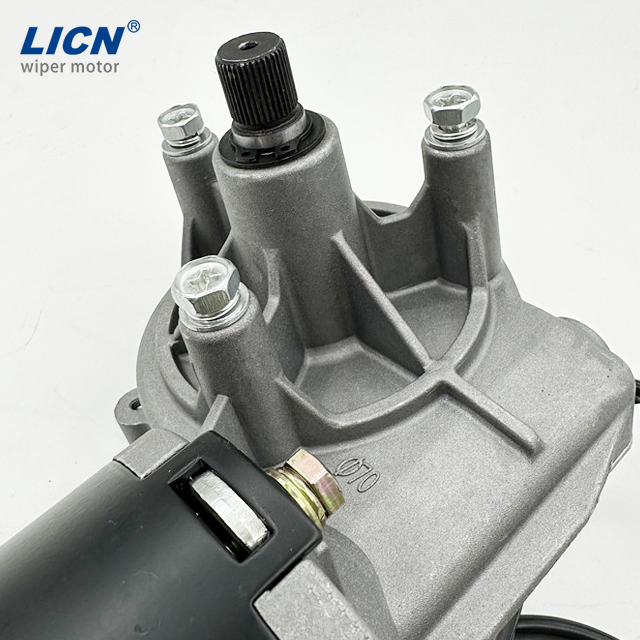
The internal mechanical architecture dictates this performance difference. Standard motors rely heavily on nylon or plastic internal worm gears to reduce manufacturing costs and minimize operational noise. Under severe stress—such as a blade frozen to the windshield—these plastic gear teeth shear off. The motor armature spins, but the output shaft remains locked, instantly destroying the unit. You can avoid this by installing a heavy duty wiper motor. These units replace vulnerable plastic components with hardened steel or bronze internal gearing. They feature reinforced output shafts supported by sealed ball bearings rather than basic brass bushings.
The electrical core also differs significantly. Heavy-duty motors utilize larger armature windings with thicker copper wire. This allows them to generate a stronger electromagnetic field and higher rotational force. The commutator in a heavy-duty motor uses thicker copper segments and higher-grade carbon brushes. This prevents the brushes from burning out when the motor is subjected to high electrical loads over extended periods. Standard motors use thin carbon brushes that wear down quickly under continuous use, leading to premature motor failure.
Evaluating the cost versus reliability trade-offs requires looking beyond the initial purchase price. Cheap, off-the-shelf motors present a lower upfront expense but lack the thermal mass and structural integrity for continuous industrial use. When forced to operate continuously under heavy loads, standard motors generate excessive internal heat. They eventually melt their brush cards or short their windings. Industrial-grade units feature cast aluminum housings designed to act as heat sinks, dissipating thermal energy efficiently. This continuous-duty capability ensures the motor survives thousands of operational hours in harsh conditions.
Specification | Standard Wiper Motor | Heavy Duty Wiper Motor |
|---|---|---|
Torque Output | 15 - 30 Nm | 50 - 120+ Nm |
Internal Gearing | Nylon / Plastic | Hardened Steel / Bronze |
Output Shaft Support | Brass Bushings | Sealed Ball Bearings |
Housing Material | Stamped Steel | Cast Aluminum |
Duty Cycle | Intermittent | 100% Continuous |
Upgrading your wiper system depends heavily on environmental exposure and friction factors. Operating environments dictate the mechanical resistance the motor must overcome. Clearing wet, heavy snow requires exponentially more force than sweeping away rain. In agricultural settings, airborne dust mixes with morning dew to form a highly abrasive, cement-like paste on the glass. Mining operations expose equipment to flying debris, mud, and slurry. In these high-friction scenarios, a standard motor will stall, overheat, and fail. A heavy-duty unit powers through the resistance, maintaining visibility and operator safety.
Application-specific demands further define the required specifications. Consider the operational realities of a bus wiper motor. Transit vehicles feature massive, vertically oriented windshields requiring long pantograph wiper arms. These systems must operate continuously for hours during storms. Highway speeds generate significant aerodynamic drag, physically pushing against the wiper blade during its upward sweep. Overcoming this wind resistance while moving a heavy blade requires substantial, sustained torque.
Conversely, a construction equipment motor faces different challenges. Excavators, loaders, and bulldozers operate at low speeds but deal with intense mechanical vibration, frequent rock strikes, and extreme debris accumulation. Their cabs often feature flat windshield geometries. This flat glass can cause wiper blades to chatter or bind if the motor lacks the rotational authority to push smoothly across the surface. These motors must also survive frequent pressure washing and prolonged exposure to silica dust.
Marine environments present another extreme use case. Saltwater spray creates a sticky, corrosive film on the glass. Wiper motors on commercial fishing vessels or tugboats must overcome this friction while resisting severe saltwater corrosion. A heavy-duty motor equipped with a stainless steel output shaft and marine-grade epoxy coating is required to survive these conditions.
Beyond traditional vehicles, custom engineering and automation frequently leverage these motors. Robotics, animatronics, and industrial mechanisms require reliable, high-torque, low-RPM output. Wiper motors offer a compact, 12V or 24V DC solution that is inherently weather-resistant and features built-in gear reduction. Engineers utilize them for everything from automated solar panel cleaning rigs to heavy-duty conveyor diverters.
Determining the exact motor required involves specific load calculations. The wiper arm acts as a lever. The longer the arm, the more torque required at the pivot point to move the blade. Follow these steps to calculate your requirements:
Measure the total length of the wiper arm from the pivot shaft to the blade attachment point.
Weigh the complete wiper arm and blade assembly.
Determine the coefficient of friction for your specific operating environment (e.g., dry glass vs. mud-covered glass).
Calculate the dynamic load the motor must move, factoring in startup inertia.
Add a 20% safety margin to your final torque calculation to account for unexpected stall conditions.
Mechanical power requires electrical power. Higher torque output directly correlates to higher amperage draw. A standard motor might draw 3 to 5 amps under normal operation, but a heavy-duty unit can easily pull 10 to 15 amps continuously. During initial startup or under stall conditions—such as a blade stuck in thick mud—the inrush current can spike to 30 amps or more. When bench-testing these motors during prototyping, you must utilize a robust power supply capable of handling massive current spikes without triggering overload protection or dropping voltage.
This increased current necessitates immediate upgrades to the wiring infrastructure. Factory wiring harnesses designed for standard motors typically utilize 18awg or 20awg wire. Pushing 15 to 20 amps through these thin wires causes severe voltage drop. This reduces motor performance and generates dangerous levels of heat. Upgrading to a high-draw motor requires transitioning the power and ground circuits to a minimum of 16awg wire. For longer wire runs, 14awg or 12awg is recommended to minimize resistance. Appropriate fusing is equally vital. A 25-amp or 30-amp fuse threshold generally provides enough headroom for startup spikes while still protecting the circuit from a dead short.
Continuous Amp Draw | Wire Run Length (0-10 ft) | Wire Run Length (10-20 ft) | Recommended Fuse Size |
|---|---|---|---|
5 - 10 Amps | 16 AWG | 14 AWG | 15 Amp |
10 - 15 Amps | 14 AWG | 12 AWG | 20 Amp |
15 - 20 Amps | 12 AWG | 10 AWG | 30 Amp |
Improper grounding is a frequent cause of motor failure. Relying on a chassis ground through a painted mounting bracket introduces high electrical resistance. This resistance starves the motor of voltage, causing it to run hot and slow. Always run a dedicated ground wire of equal or larger gauge directly from the motor to a central grounding busbar or the negative battery terminal.
Switching high current loads directly through a dashboard switch is a guaranteed point of failure. The delicate contacts inside cabin switches will arc, pit, and eventually weld shut when exposed to 20-amp loads. Technical integration requires traditional automotive relays or modern solid-state Power Distribution Modules (PDMs). A device like a PDM32 allows a low-current signal from the dashboard switch to trigger a high-current solid-state circuit. This safely delivers power directly from the battery to the motor, isolating the sensitive cabin electronics from the harsh electrical demands.
Most industrial wiper motors feature multi-speed functionality, typically wired through a standard 5-wire configuration. This setup generally includes dedicated wires for high speed, low speed, park (which returns the blade to the bottom of the glass when turned off), ground, and ignition power. When integrating these motors into custom applications, speed reduction often becomes necessary. Utilizing internal resistor networks to drop the speed generates excessive waste heat and significantly reduces the motor's torque output. Instead, integrating a Pulse Width Modulation (PWM) controller allows for precise speed reduction. PWM rapidly pulses the full voltage on and off, maintaining maximum rotational torque while lowering the RPM. This ensures the motor still performs under heavy loads at low speeds.
Advanced heavy-duty motors feature dynamic parking mechanisms. Instead of simply cutting power, the motor actively shorts its own windings when the switch is turned off. This acts as an electromagnetic brake, stopping the heavy wiper arms instantly at the bottom of the glass rather than allowing them to coast across the windshield.
Thermal management dictates the continuous operation capabilities of the motor. Standard motors suffer thermal shutdown if run continuously for hours. Their stamped steel housings trap heat around the internal brush card. Heavy-duty motors utilize cast housings with integrated cooling fins. This thermal mass absorbs and dissipates heat into the surrounding air, allowing the motor to achieve a 100% duty cycle in demanding environments like marine navigation or heavy snow clearing.
Environmental exposure requires strict adherence to Ingress Protection (IP) ratings. Motors mounted externally on agricultural tractors, marine bulkheads, or construction cabs face direct exposure to rain, pressure washers, and dust.
IP65: Protects against low-pressure water jets from any direction. Suitable for enclosed cabs.
IP66: Withstands powerful water jets and heavy seas. Required for externally mounted equipment exposed to pressure washing.
IP67: Guarantees protection against temporary submersion. Necessary for extreme off-road or marine applications.
Achieving these ratings requires the manufacturer to utilize heavy-duty O-rings, sealed bearings, and potted electronics. This directly connects the IP rating to the ultimate longevity of the system.
Upgrading the motor without addressing the surrounding mechanical infrastructure introduces severe failure points. The most common risk involves mechanical linkage stress. If you pair a 100 Nm motor with thin, stamped-steel wiper transmissions designed for a 20 Nm motor, the increased rotational force will buckle the linkage rods. The connection point between the motor shaft and the wiper arm often relies on a splined interface. Mismatched torque will strip the soft aluminum splines completely smooth. The motor will spin freely while the wiper blade remains stationary. You must upgrade the entire linkage assembly to match the motor's output.
The spring tension within the wiper arm itself also impacts motor performance. Heavy-duty arms use stiff springs to keep the blade pressed against the glass at highway speeds. This high spring tension increases the friction the motor must overcome. If you install high-tension arms on a standard motor, it will stall immediately. Ensure your motor is rated to handle the specific tension of your chosen wiper arms.
Electrical overload presents a severe fire hazard. Utilizing existing, undersized factory wiring harnesses for high-draw motors will melt the wire insulation and potentially ignite surrounding components. Mitigation requires completely bypassing the factory power delivery system. Install dedicated power circuits routed directly from the battery or a primary PDM. Utilize appropriately gauged wire and inline fuses located as close to the power source as possible.
Space constraints and mounting configurations frequently complicate installation. High torque motors contain larger magnets, heavier copper windings, and robust gearboxes. They are physically larger and significantly heavier than standard units. Attempting to mount a heavy-duty motor to a thin sheet metal firewall will result in structural flex during operation. This flex eventually causes metal fatigue and cracking. Mitigation requires fabricating reinforced mounting brackets, typically utilizing 3mm or thicker steel. Ensure adequate physical clearance around the motor to prevent interference with other under-dash or engine bay components.
Selecting the right manufacturing partner determines the success of your integration. When evaluating a wiper motor supplier, demand transparency regarding their quality control and testing standards. Reliable suppliers provide documented data on stall torque tests, proving the motor's maximum force before failure. Look for extensive salt spray testing data (e.g., 500+ hours via ASTM B117) to verify corrosion resistance for marine or winter road applications. Lifecycle continuous run tests, often exceeding one million wipe cycles, validate the durability of the internal gearing and brush cards.
Assess the supplier's customization capabilities versus their off-the-shelf availability. Adapting a standard heavy-duty unit works for basic replacements, but OEM vehicle manufacturing and custom automation often require specific parameters. A capable supplier can modify the internal gearing to provide custom sweep angles. Standard angles include 90, 110, or 130 degrees. They can also offer extended shaft lengths to penetrate thick armored bulkheads or insulated cabin walls.
Specify the exact electrical connectors required for your application. A reliable supplier will offer motors pre-wired with sealed Deutsch DT or Amphenol connectors rather than cheap, unsealed bullet terminals. Sealed connectors prevent moisture ingress, which is a primary cause of electrical shorts in off-road and marine environments.
Evaluate the supplier's warranty, technical support, and supply chain reliability. Complex integrations require accurate wiring schematics, 3D CAD models for spatial planning, and direct engineering support for troubleshooting PWM controller compatibility. For fleet operators and heavy machinery manufacturers, reliable lead times and a stable supply chain are mandatory to maintaining operational uptime and preventing assembly line delays.
Audit your current wiper system failure rates to identify underspecified components causing equipment downtime.
Calculate your specific torque and sweep angle requirements based on your windshield geometry, arm length, and blade weight.
Upgrade your electrical infrastructure by installing appropriate wire gauges, relays, and fuses to handle the increased amperage draw.
Reinforce your mechanical linkages and mounting brackets to withstand the elevated rotational force of a heavy-duty motor.
Consult with a specialized supplier to acquire technical drawings, evaluate testing data, and source prototypes for physical validation.
A: Standard automotive wiper motors typically produce between 15 and 30 Nm of torque. Heavy-duty industrial wiper motors produce significantly more, ranging from 50 Nm to over 120 Nm. Estimating your exact requirement depends on the length of the wiper arm, the weight of the blade assembly, and the friction coefficient of the operating environment.
A: Yes. High torque motors draw substantial current, often exceeding 15 amps continuously and spiking over 30 amps during startup or stall conditions. Standard cabin switches cannot handle this load and will arc or melt. Relays or Power Distribution Modules (PDMs) safely switch this high current directly from the battery.
A: Due to the high amperage draw of heavy-duty bus motors, factory 18awg or 20awg wiring is insufficient and poses a fire risk. You must use a minimum of 16awg wire for power and ground circuits. For longer wire runs common in large transit vehicles, upgrading to 14awg or 12awg is recommended to prevent voltage drop.
A: Most 2-speed motors utilize a 5-wire setup with dedicated high and low-speed circuits. For custom speed reduction below factory settings, use a Pulse Width Modulation (PWM) controller. PWM maintains the motor's high torque output at low speeds, unlike internal resistor networks which generate waste heat and reduce rotational force.
A: Cheap motors use plastic internal worm gears, basic brass bushings, and thin stamped housings that trap heat. Expensive, industrial-grade motors feature hardened steel or bronze gearing, sealed ball bearings, and cast aluminum housings for thermal dissipation. They are designed for continuous duty cycles and feature high IP ratings for weather resistance.
A: Yes, provided it is an industrial-grade motor. Heavy-duty motors are engineered with significant thermal mass, often utilizing cast aluminum housings with cooling fins to dissipate heat. This prevents the internal brush cards and windings from melting, allowing for a 100% duty cycle during continuous, hours-long operation in harsh environments.
A: Absolutely. Wiper motors are highly popular in custom engineering because they provide reliable, high-torque, low-RPM output in a compact 12V or 24V package. They feature built-in gear reduction and weather sealing. However, you must use a robust bench power supply capable of handling sudden inrush current spikes during prototyping.


