
Views: 0 Author: Site Editor Publish Time: 2026-08-12 Origin: Site


Selecting the correct voltage for a vehicle wiper system extends beyond matching a spec sheet. It dictates electrical system stability, wire gauge requirements, and long-term mechanical reliability under heavy loads. Whether upgrading a legacy commercial fleet, replacing a failed component, or engineering a custom solution like an off-road retrofit or DIY robotics platform, decision-makers must understand the distinct differences in current draw, thermal management, and power delivery between 12-volt and 24-volt architectures. A mismatch in voltage leads to melted wiring harnesses or severely degraded mechanical performance.
This guide breaks down the technical specifications, performance trade-offs, and application-specific criteria to help you evaluate and select the optimal motor for your equipment. We will examine the underlying electrical principles and physical construction differences so you can make an informed engineering decision that ensures long-term operational reliability in the field.
The Power Equation Reality: Both 12V and 24V motors can deliver identical mechanical power, but a 24V system achieves this with half the current (amps), significantly reducing thermal load and electrical stress.
Application Boundaries: A 12V wiper motor is the standard for passenger vehicles, light-duty applications, and custom 12V DIY projects, while a 24V wiper motor is essential for heavy-duty commercial vehicle motors, military surplus upgrades, and systems requiring long wire runs.
Identification is Crucial: Before purchasing a replacement, physically verifying the stock motor's data plate and testing the harness voltage is mandatory to prevent catastrophic electrical mismatches.
Implementation Constraints: Swapping voltages is not a plug-and-play operation; it requires comprehensive electrical system audits, including appropriate relays, switches, and wiring harnesses.
Sourcing Strategy: Partnering with a specialized wiper motor manufacturer ensures OEM-grade winding quality, accurate torque ratings, and appropriate IP (Ingress Protection) ratings regardless of the chosen voltage.
To properly evaluate any 12V 24V wiper motor, you must first examine the fundamental electrical relationship defined by Watt's Law. Power (Watts) equals Voltage (Volts) multiplied by Current (Amps). This equation dictates how electrical energy converts into the mechanical force required to drag rubber blades across a glass surface. If a specific wiper linkage requires 120 watts of power to clear heavy snow, a 12-volt motor must draw 10 amps from the electrical system to achieve that output. A 24-volt motor requires only 5 amps to deliver the exact same 120 watts of mechanical power.
This reduction in amperage fundamentally alters the thermal efficiency of the system. According to Joule's First Law, the heat generated within an electrical circuit is proportional to the square of the current. Because the 24-volt system operates at half the amperage, it generates substantially less heat in the wiring harness, the relay contacts, and the motor brushes during continuous operation. While the mechanical output—measured in torque and rotational speed—can be engineered to be identical across both voltages, the 24-volt architecture offers superior thermal efficiency. This lower thermal load prevents premature degradation of the internal insulation and extends the operational lifespan of the motor during heavy duty cycles.
The physical manufacturing of a direct current (DC) motor changes significantly depending on its target voltage. Inside a 12-volt motor, the armature is wound with thicker copper wire. This heavy-gauge wire safely carries the higher amperage without overheating and melting the protective enamel coating. Because the wire is thicker, the manufacturer can only fit a limited number of turns around the armature core. This specific configuration of thick wire and fewer windings generates the required magnetic field at 12 volts.
A 24-volt motor utilizes noticeably thinner copper wire for its armature windings. Since the current draw is cut in half, the wire does not need the same cross-sectional area to dissipate heat. To generate the same electromagnetic field strength as the 12-volt counterpart, the thinner wire must be wrapped around the armature core with significantly more turns. These internal structural differences directly impact the manufacturing process. The higher turn count in 24-volt motors requires precise winding machinery to ensure tight, uniform coils. The difference in current also dictates brush material selection. 12-volt motors often require denser, higher-copper-content brushes to handle the increased electron flow without excessive arcing and wear against the commutator.
The 12V wiper motor remains the undisputed standard across the vast majority of passenger automotive electrical systems. Nearly all modern sedans, light trucks, and SUVs operate on a nominal 12-volt architecture, typically charging at 13.8 to 14.4 volts from the alternator. This ubiquity creates a massive, highly standardized ecosystem for replacement parts. Finding a compatible 12-volt motor, along with the necessary intermittent delay relays, park-position switches, and control stalks, is straightforward and highly accessible for mechanics and fleet managers.
For light utility vehicles, golf carts, and side-by-side UTVs, the 12-volt standard simplifies electrical integration. These vehicles typically utilize a single 12-volt lead-acid or lithium battery. Introducing a different voltage would require complex secondary circuits. The existing 12-volt infrastructure allows engineers to easily tap into the main fuse block, utilizing standard automotive-grade wiring and readily available inline fuses to protect the wiper circuit.
Beyond automotive applications, the 12-volt architecture is highly sought after in custom fabrication and DIY robotics. Builders of sim racing rigs, automated props, and custom conveyor systems frequently repurpose these motors. The primary appeal lies in the integrated worm gear drive. This gear reduction mechanism provides immense torque at relatively low rotational speeds, ideal for moving heavy physical loads. A worm gear inherently prevents back-driving. The output shaft holds its position firmly when power is disconnected, acting as a mechanical brake.
When integrating a 12-volt motor into a custom robotics project, builders often rely on PWM controllers to manage speed. A PWM controller rapidly switches the power on and off thousands of times per second. This allows precise control over the wiper arm speed without sacrificing torque. Because 12-volt PWM modules are mass-produced for the RC and hobbyist markets, they are incredibly cheap and easy to source. Attempting to find a comparable PWM controller rated for a 24-volt system often requires stepping up to expensive industrial automation hardware.
Despite its versatility, the 12-volt architecture faces severe limitations when scaled up to handle massive mechanical loads. In applications requiring large windshields—such as marine vessels, agricultural combines, or heavy construction equipment—the wiper arms and blades are exceptionally heavy. Clearing thick mud, wet snow, or heavy sea spray demands high torque, which demands high wattage. Pushing a 12-volt motor to deliver this wattage results in massive amperage spikes.
These high amperage requirements create significant electrical bottlenecks. The most prominent issue is voltage drop over long wire runs. If a boat requires a 20-foot wire run from the battery to the wheelhouse, the resistance in the copper wire consumes a portion of the voltage. A 15-amp draw on a 12-volt circuit over that distance might result in only 10.5 volts reaching the motor. This voltage starvation leads to sluggish wiper performance, increased heat generation within the motor windings, and a high probability of the motor stalling mid-stroke under heavy load.
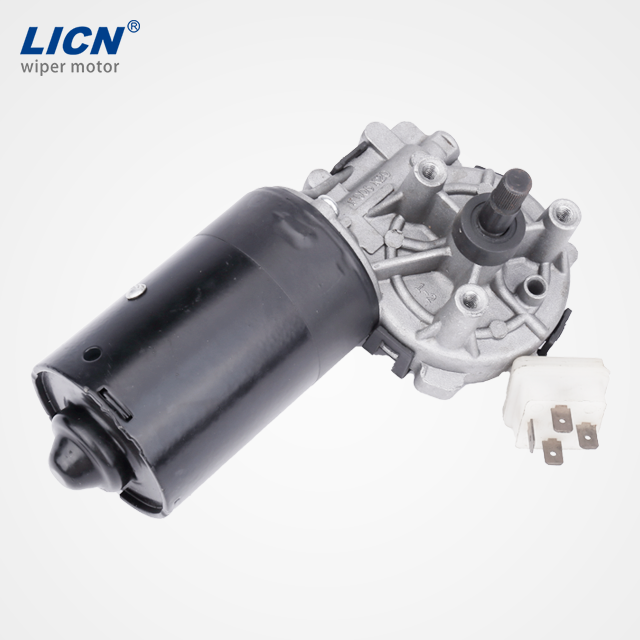
Transit buses, heavy-duty transport trucks, earth-moving excavators, and commercial marine vessels almost exclusively default to 24-volt electrical architectures. In these environments, a 24V wiper motor is a strict engineering requirement. The physical dimensions of the glass on a transit bus or a wheel loader require wiper arms that can exceed 40 inches in length. Moving these oversized components against high wind resistance and heavy precipitation requires sustained, high-wattage output.
By utilizing a 24-volt system, commercial equipment manufacturers deliver the necessary mechanical force without overloading the vehicle's electrical circuits. A commercial vehicle motor operating at 24 volts maintains a low current profile even when the wiper blades are pushing heavy, wet snow. This low amperage prevents the vehicle's alternators and battery banks from experiencing severe voltage sags when multiple high-draw systems like hydraulic pumps, HVAC blowers, and lighting operate simultaneously.
The rugged durability of 24-volt components makes them highly desirable in the off-road and expedition vehicle communities. Builders frequently source 24-volt military surplus parts, such as replacement wiper motors from decommissioned tactical vehicles, for civilian off-road builds. These motors are typically over-engineered, featuring sealed housings, heavy-duty gearboxes, and extreme temperature tolerances.
Integrating a 24-volt motor into a standard 12-volt civilian Jeep or truck requires specific electrical modifications. Builders cannot simply wire the motor to the existing fuse box. Wiring a dual-battery setup for a 24-volt retrofit requires careful planning. You must connect two identical 12-volt batteries in series. The positive terminal of the first battery connects to the negative terminal of the second battery. The remaining positive and negative terminals provide the 24-volt output. However, you cannot charge this series bank using a standard 12-volt vehicle alternator without a specialized battery isolator or a dedicated 24-volt secondary alternator. Failing to manage the charging circuit correctly will result in dead batteries and a non-functioning wiper system when you need it most.
The primary engineering advantage of the 24-volt architecture lies in wire gauge reduction. Because current dictates the required thickness of a wire, halving the amperage allows manufacturers to use significantly thinner wiring harnesses. A heavy-duty 12-volt wiper circuit might require thick 10 AWG wire to prevent voltage drop over a long chassis run. The exact same mechanical load on a 24-volt system can be safely powered using thinner 16 AWG wire.
In the context of manufacturing large commercial vehicles, this reduction in wire gauge translates to massive weight savings. Copper is heavy. Reducing the wire thickness across miles of internal vehicle wiring improves fuel efficiency. The lower amperage significantly reduces the risk of electrical arcing. Switches, relays, and multi-pin connectors experience far less thermal stress, drastically lowering the failure rate of the control infrastructure over the vehicle's lifespan.
Before purchasing replacement parts or planning a system upgrade, you must accurately identify the native voltage of your existing wiper hardware. Guessing based on vehicle size leads to expensive component failures. The most reliable method is locating the manufacturer's data plate. This metal tag or heavy-duty sticker is typically riveted or adhered directly to the motor's cylindrical housing. Clean off any grease or dirt to read the stamped OEM part numbers, continuous duty cycle ratings, and the explicit voltage specification, usually marked as 12VDC or 24VDC.
If the data plate is missing or illegible, perform a multimeter verification. Disconnect the wiring harness from the motor. Set your digital multimeter to read DC voltage. Turn the vehicle's ignition to the accessory position and activate the wiper switch on the dashboard. Probe the power and ground terminals on the harness connector. A reading between 11.5V and 14.4V confirms a 12-volt system, while a reading between 23V and 28.8V confirms a 24-volt system. Always test the harness under a simulated load if possible to account for surface charge.
A persistent misconception in automotive electrical modification is that a 24-volt system inherently possesses more mechanical torque than a 12-volt system. This is factually incorrect. Torque is a function of the internal gear reduction ratio, the physical size of the armature, and the strength of the permanent magnets inside the housing. It is not strictly dictated by the input voltage.
A well-engineered 12-volt motor with a high-ratio worm gear produces significantly more torque than a poorly designed 24-volt motor with a low-ratio gear. When evaluating motors, look past the voltage and examine the stall torque rating, usually measured in Newton-meters or inch-pounds. Voltage determines how efficiently the motor receives its electrical power, but the gearbox determines how that power translates into rotational force against the windshield.
The mechanical linkage connecting the motor to the wiper arms plays a massive role in the overall electrical load. A binding linkage with dry, unlubricated pivot shafts forces the motor to work harder, driving up the amperage. Before condemning a motor or deciding to upgrade the voltage, mechanics must disconnect the linkage from the motor pitman arm and test the physical resistance by hand. If the linkage requires significant force to move, installing a new motor will not solve the underlying issue. The increased friction will simply cause the new motor to draw excessive current, leading to premature failure regardless of whether it is a 12-volt or 24-volt unit.
The supporting electrical infrastructure must perfectly match the voltage of the motor. You cannot mix and match control components. A 12-volt intermittent delay relay installed on a 24-volt circuit will experience immediate coil failure and likely melt the internal contacts. A 24-volt relay installed on a 12-volt circuit will fail to actuate because the magnetic field generated by the lower voltage is insufficient to pull the contacts closed.
When engineering a complete system, evaluate the entire control chain. The dashboard switch, the park-position sensor inside the motor gearbox, the inline fuses, and the timer modules must all be rated for the specific system voltage. The physical connectors must be rated for the expected amperage. A connector that is perfectly safe for a 5-amp 24-volt load might overheat and melt if subjected to the 10-amp draw of an equivalent 12-volt load.
Technical Comparison: 12V vs 24V Wiper Systems (Assuming identical 150W mechanical load) | ||
Specification Parameter | 12V Wiper Architecture | 24V Wiper Architecture |
|---|---|---|
Operating Current (Amps) | 12.5 Amps | 6.25 Amps |
Recommended Wire Gauge (20ft run) | 10 AWG | 16 AWG |
Thermal Heat Generation | High (Requires robust heat dissipation) | Low (Highly efficient continuous duty) |
Relay & Switch Stress | High (Prone to contact arcing over time) | Low (Extended component lifespan) |
Primary Application Environment | Passenger cars, light trucks, DIY robotics | Transit buses, heavy machinery, marine vessels |
Selecting the right wiper motor manufacturer is as critical as selecting the correct voltage. A high-quality supplier provides comprehensive technical documentation, allowing engineers to make precise calculations. When evaluating a manufacturer, demand to see continuous duty cycle ratings. A motor might survive a 5-minute test run on a bench, but fail during a 4-hour continuous operation in a blizzard.
Scrutinize the Ingress Protection (IP) ratings. For external or exposed applications, look for IP66 (protection against heavy water jets) or IP67 (protection against temporary submersion) certifications. This ensures the internal commutator and brushes are protected from dust, salt spray, and moisture. Verify the availability of custom shaft configurations and request load-testing data that explicitly outlines the stall torque and no-load speed for both their 12-volt and 24-volt variants.
Installing a motor with the incorrect voltage rating results in immediate system failure. Running a 12-volt motor on a 24-volt circuit is a catastrophic hazard. The motor attempts to draw massive amounts of current, spinning at double its intended speed for a brief period before the internal heat melts the armature windings. This scenario frequently results in dead shorts, blown main fuses, and presents a severe electrical fire hazard within the vehicle dashboard.
Running a 24-volt motor on a 12-volt circuit results in severe underperformance. The motor lacks the electromagnetic force required to overcome the physical friction of the wiper blades against the glass. The system exhibits sluggish performance, fails to return to the park position, and ultimately stalls. A stalled motor acting as a dead load quickly overheats its own windings, even at the lower voltage, eventually destroying the component.
When retrofitting a vehicle wiper motor to a different voltage standard, engineers must choose between dedicated battery circuits and DC-to-DC converters. If converting a 12-volt vehicle to run a heavy-duty 24-volt wiper system, installing a step-up converter is the most common approach. This converter must be specified based on the motor's peak stall current, not its nominal running current. If the motor draws 4 amps while running but spikes to 20 amps when jammed by ice, the converter must be rated for at least 25 amps to prevent failure.
To successfully execute a voltage conversion in the field, follow a strict sequence of operations:
Map the existing wiring harness to identify all splices, inline fuses, and relay locations.
Isolate the wiper circuit from the main fuse block to prevent back-feeding voltage into sensitive vehicle control modules.
Mount the DC-to-DC converter in a location with adequate airflow, as these units generate significant heat under continuous load.
Upgrade the ground strap connecting the wiper motor housing to the vehicle chassis, ensuring a clean, low-resistance return path for the electrical current.
Using a step-down converter (24V to 12V) is common when installing lightweight 12-volt accessories in commercial trucks. While step-down converters are generally cheaper and more efficient, they introduce a single point of failure. If the converter's internal regulation fails, it may pass the full 24 volts directly to the 12-volt wiper motor, destroying it instantly. To mitigate this risk, always install fast-acting overvoltage protection relays downstream of any voltage conversion equipment.
The choice between a 12V and 24V wiper motor should be dictated strictly by the native electrical architecture of the vehicle and the physical load demands of the wiper assembly, rather than a perceived upgrade in mechanical power. To ensure a successful installation and long-term reliability, follow these actionable steps:
Physically verify the voltage of your existing electrical harness using a digital multimeter under load before ordering replacement components.
Inspect all existing wiring, relays, and dashboard switches for signs of thermal damage, replacing any components that do not match the target voltage rating.
Calculate the required wire gauge based on the total length of the circuit run to prevent voltage drop, especially in 12-volt marine or custom applications.
Request verified load-testing data and IP certifications from your manufacturer to ensure the motor can survive your specific environmental conditions.
Size any required DC-to-DC converters based on the absolute maximum stall current of the motor to prevent catastrophic converter failure during winter weather.
A: No. Supplying 24 volts to a 12-volt motor causes it to spin at excessive speeds, draw too much current, and rapidly overheat. This melts the internal armature windings, destroys the brushes, and creates a severe fire hazard in your vehicle's electrical system.
A: Not inherently. Torque is determined by the motor's physical size, magnetic field strength, and the internal gear reduction ratio. A 24-volt system is more electrically efficient and uses thinner wire, but a properly geared 12-volt motor produces identical mechanical torque.
A: Disconnect the motor harness and use a digital multimeter set to DC voltage. Turn the vehicle ignition on and activate the wiper switch. Probe the harness terminals. A reading near 12-14V indicates a 12V system, while 24-28V indicates a 24V system.
A: The motor will be severely underpowered. It operates sluggishly, fails to clear heavy rain or snow, and likely stalls against the friction of the windshield. The internal park switch may also fail to engage, leaving the wipers stuck in the middle of the glass.
A: Heavy-duty vehicles use large, heavy wiper blades that require significant wattage to move. A 24-volt system delivers this high power while drawing half the amperage of a 12-volt system. This allows manufacturers to use thinner wiring and prevents relays from burning out under continuous heavy loads.
A: Yes, you can use a 24V to 12V DC-to-DC step-down converter. You must size the converter to handle the peak stall current of the 12V motor, not just the running current, to prevent the converter from failing when the wipers encounter heavy resistance.


